The Hidden Paper Menu Cost Restaurants Ignore
The real paper menu cost goes far beyond printing. We break down the reprints, lost sales, and labor hours that quietly drain your restaurant's margins.
On this page 6
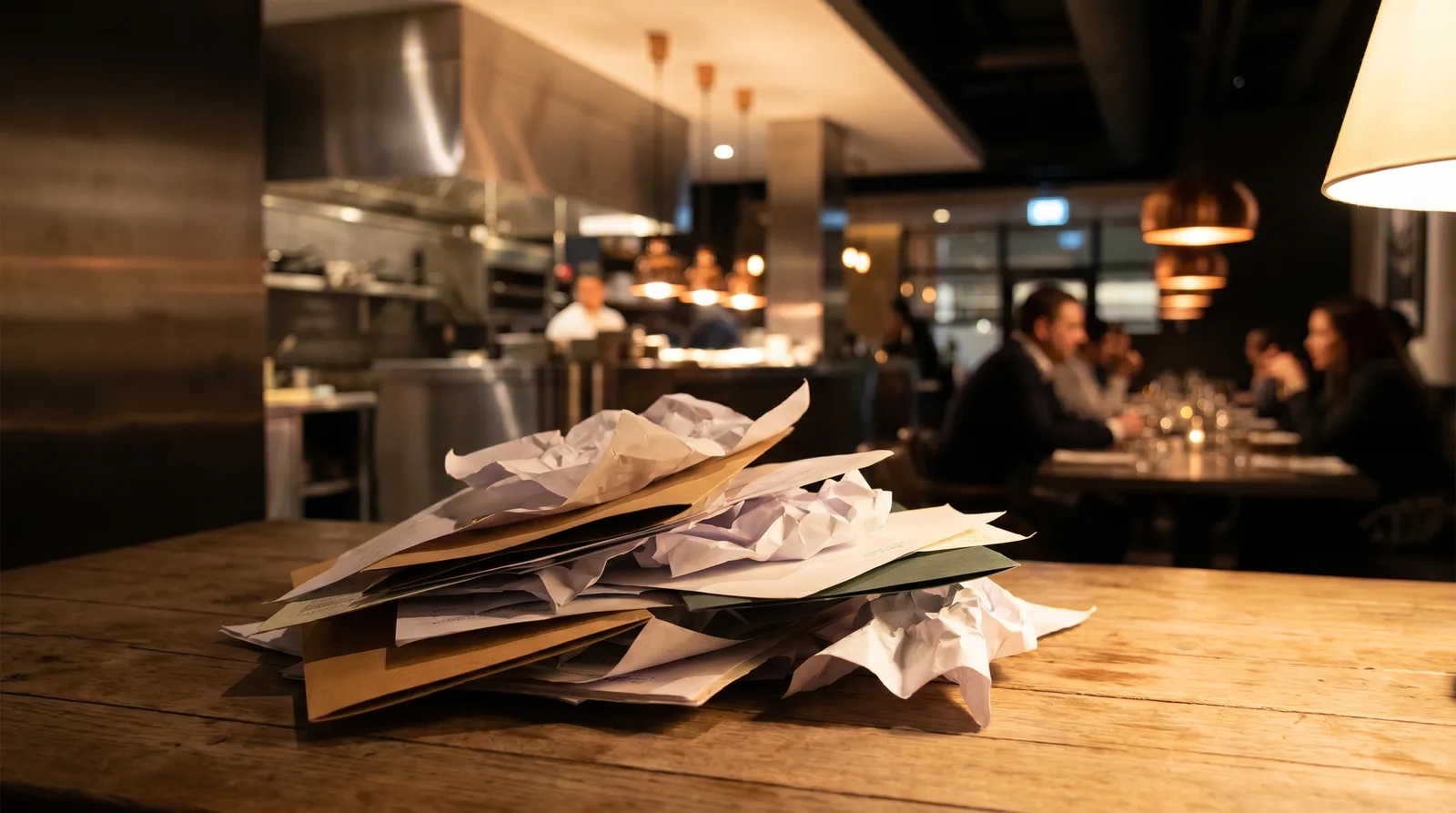
A restaurant owner in Lyon once described her storage room to us: three cardboard boxes of obsolete menus, each one rendered useless by a single change. A supplier price hike. A new sommelier's wine list. A typo in the dessert section that nobody caught until a regular pointed it out. Every box represented a print invoice, but the invoice was the smallest part of her true paper menu cost.
That is the trap of the paper menu cost. The number on the printer's bill is visible and easy to budget for. The expenses hiding underneath it are larger, recurring, and almost never tracked.
The Paper Menu Cost of the Reprint Cycle
Most operators think of menu printing as an occasional expense. In reality, it is a cycle. The average full-service restaurant updates its menu several times a year, and each update triggers a fresh print run plus design fees if the layout changes.
Industry estimates put a professional reprint anywhere from a few hundred to over a thousand dollars per run, depending on paper stock, lamination, and quantity. Multiply that by four or five updates a year and the true paper menu cost climbs into the thousands before you have sold a single extra plate.
The cycle also has a hidden tax: timing. You cannot reprint instantly, so you wait until you have enough changes to justify a run. That means your menu is frequently out of date. Prices lag behind your food costs. Discontinued items stay listed. Every gap between reality and what is on the table is money left on the floor.
The Sales You Lose to a Static Page
A paper menu is frozen the moment it leaves the printer. It cannot react to what is happening in your kitchen or your dining room, and that rigidity quietly suppresses revenue.
Consider the everyday scenarios. The kitchen runs out of the branzino at 8 PM, but it stays on every table, so servers waste time taking orders they cannot fulfill and guests feel let down. A high-margin special sells out by Saturday lunch with no easy way to push the next one. A supplier raises beef prices 12% and your menu keeps charging last quarter's rate for weeks.
Photography is another silent loss. Paper has limited space, so most dishes appear as text only. Research compiled by Toast shows that menus with strong visuals and descriptive language consistently lift average order value, because diners order what they can see and imagine. A static sheet caps how much of that lift you can capture.
The Labor Hours You Are Paying Twice
The paper menu cost is not only material. It is staff time, and staff time is your most expensive line item.
Someone has to proofread every new version, send files back and forth with a designer, drive to collect the print run, and physically swap out menus across the floor. For a multi-location group, that swap happens at every site, often by managers earning a premium hourly rate. None of this work generates revenue. It is pure overhead spent keeping a document barely current.
There is a quieter cost too: lost institutional knowledge. When pricing and item history live only on printed sheets, you have no easy record of what changed, when, or how it performed. You are running your most important sales asset blind.
What Changes When the Menu Goes Live
The fix is not a better print workflow. It is removing the print cycle entirely. A digital QR menu turns your most static asset into a live one you control in seconds.
This is the core of what Vino does: it replaces reprint cycles with instant digital updates. Sell out of a dish and remove it from every table at once. Adjust a price the same morning your supplier cost moves. Launch a weekend brunch menu Friday night and have it live by Saturday. The change is instant, free, and consistent across every location through a single multi-location dashboard.
The platform also closes the gaps paper leaves open. AI photo enhancement turns a phone snapshot into an appetizing image without a photographer, and AI auto-translation makes the same menu readable for international guests. Menu analytics finally show you which items actually sell, so pricing and layout decisions rest on data instead of guesswork. Together these features turn the menu from a recurring printing liability into a live sales tool.
How to Calculate Your Own Paper Menu Cost
Before you decide anything, put a real figure on what paper costs you today. Pull your last twelve months and add up four lines:
- Print and design fees: every run, including rush charges and lamination.
- Labor: hours spent proofing, coordinating, and swapping menus, multiplied by the loaded wage of whoever does it.
- Lost margin from stale pricing: the weeks your prices trailed your food costs, even a rough estimate.
- Missed upsell: dishes you could not feature or reposition fast enough.
Most owners are surprised that printing is often the smallest of the four. Once you see the full picture, the case for going digital stops being about hygiene or trends and becomes a straightforward margin decision.
The Bottom Line
Paper menus feel cheap because the only cost you ever see is the print invoice. The expensive parts - the reprint cycle, the suppressed sales, the labor paid twice - stay hidden until you add them up. For most restaurants, that hidden total dwarfs the sticker price several times over.
You do not have to keep paying it. Run the four-line calculation above for your own restaurant, then see how much an instantly updatable digital menu would save. Explore Vino's pricing to find the plan that fits your room, and turn your menu from a recurring expense into an asset that works for you in real time.
Ready to go digital?
Create your restaurant's smart digital menu in minutes with Vino. No app downloads, no complicated setup.
Related articles
We Analyzed 30,000 QR Menu Interactions. Here Is the Data on How Diners Really Read Your Menu.
8 min read

Why Every Restaurant Owner Needs a Peer Community
5 min read
Digital Menu Without a POS: Toast & Square Alternatives
6 min read

Digital Menu Customer Journey for Customer Retention
6 min read